Acknowledging disabilities is important in terms of keeping my product
available to almost anyone who has access to a technological device. With that
being said I do not know if I will be able to cater for disabilities with the
short time frame that I have to complete this project. Due to this factor I am
researching into disabilities and possible solutions which will be added to my
future work if I run out of time.
Colour Blindness
Out of a pack of 24 coloured pencils an individual with mild condition of red/green colour deficiency will only be able to distinguish 5 coloured pencils that do not have nor red or green within. The image below shows various examples of different colour blindness examples according to what colours the individual can detect.

There are different types of colour deficiency which I will explain below:
Colour blindness can also be referred to as colour deficiency it is
most commonly inherited although other factors such as strong medicines
(used at large amount for long period of time), diabetes and multiple
sclerosis can also lead to colour deficiency. People confuse colour blindness
with the ability to have poor vision in fact most people with
condition can see and detect objects clearly they just can't define some of the
colours. The condition can actually be so minimal that people might not even be
aware that they suffer from the condition.
Out of a pack of 24 coloured pencils an individual with mild condition of red/green colour deficiency will only be able to distinguish 5 coloured pencils that do not have nor red or green within. The image below shows various examples of different colour blindness examples according to what colours the individual can detect.
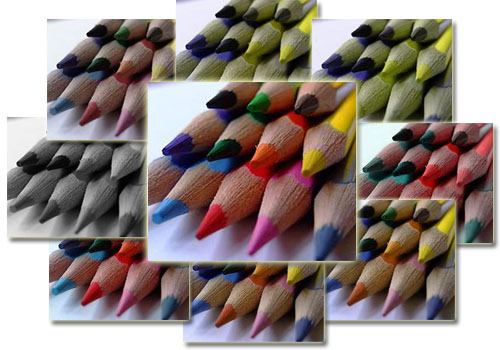
There are different types of colour deficiency which I will explain below:
Red/Green: This is the most common form of colour deficiency found, the
term doesn't mean they mix up both colours it mainly refers to all colours. We
need to acknowledge that red is a primary colour and many other colours
are a mixture of it. People with this colour deficiency tend to not be able to
detect colours such as pink and purple because of the absence to be able to
see the red within the colour.
Anomalous Trichromacy: This refers to an individual who is only slightly colour blind, one out of the three cones within the eye is altered therefore the overall colour seen is not 100% correct this is mainly seen between red/green or blue/yellow.
Protanomaly: Lack of being able to detect red therefore colours such orange and red do not appear as vibrant
Deuteranomaly: Lack of being able to detect green this is the most common type found within this category as it is easily inherited by a gene found in the X chromosome.
Tritanomaly: Lack of being able to detect blue this is the most rare type found although people with this condition seem to be able to detect red and green colours.
Monochromacy: This is the rarest form (found 1 of 33,000) of colour deficiency where individuals cannot see any form of colour only black/grey/white. They have sensitivity to light therefore they need to wear dark glasses to help with the sensitivity.
Visual Impairment
Physical
A physical disability refers to the physical aspect of the person where he/she will struggle to move various parts of their body.
I have listed some physical disabilities below:
Visual impairment refers to sight loss that cannot
be improved through the use of glasses or lenses whether it may be
minor or extreme.
Physical
A physical disability refers to the physical aspect of the person where he/she will struggle to move various parts of their body.
I have listed some physical disabilities below:
- Arthritis
- Cerebral Palsy
- Multiple Sclerosis
- Spina Bifida
Catering for Disabilities
Although
the production process of my application has not yet started I am confident
that some of these disabilities will be taken into consideration and if
possible I will implement a structure that caters for it. I would need to
incorporate other functions within my app to cater for the colour blind which I
seem to have done so to an extent so far. The most rare form
is monochromacy where people will only be able to see grey, black and
white; I have already decided on using a neutral effect on my interface
therefore this area should not be such a problem. When it comes to
visual impairment forms of catering for it would be to implement a zoom or
a view percentage (seen on Microsoft Interfaces) where users can adjust the
size of the view. The only problem with the view percentage is that
the closer a user gets the more features will not be displayed at once on
a screen. Regarding the physical disabilities, it will be a lot harder for me to
cater for those who might need a piece of hardware to assist them. Although I
can say that using a voice input could be a form of solution where no typing is
needed.
Sources
Colour Blind Awareness. n.d. Types of Colour Blindness. [online] Available at: http://www.colourblindawareness.org/colour-blindness/types-of-colour-blindness/ [Accessed: 19 Oct 2013].
Colour Blind Awareness. n.d. Colour Blindness. [online] Available at: http://www.colourblindawareness.org/colour-blindness/ [Accessed: 19 Oct 2013].
Unknown. n.d. Color Blindness. [image online] Available at: http://www.color-blindness.com/wp-content/images/color-blindness-simulator-e.jpg [Accessed: 19 Oct 2013].
Testing Color Vision. n.d. Anamalous Trichromacy. [online] Available at: http://www.testingcolorvision.com/tcv-anomalous-trichromacy.php [Accessed: 19 Oct 2013].
NHS Choices. 2012. Visual impairment. [online] Available at: http://www.nhs.uk/Conditions/Visual-impairment/Pages/Introduction.aspx [Accessed: 19 Oct 2013].
imvc. n.d. Physical Disability. [online] Available at: http://www.imvc.com.au/broaden-your-horizons/disability-information/physical-disability/ [Accessed: 19 Oct 2013].
imvc. n.d. Physical Disability. [online] Available at: http://www.imvc.com.au/broaden-your-horizons/disability-information/physical-disability/ [Accessed: 19 Oct 2013].
Physical Disability Council of NSW. n.d. What is Physical Disability?. [online] Available at: http://www.pdcnsw.org.au/index.php?option=com_content&view=article&id=49&Itemid=118 [Accessed: 26 Oct 2013].

No comments:
Post a Comment